
How to Brief a Custom Jewelry Manufacturer With a Rough Sketch
A rough sketch is a valid starting point. Hand drawings, reference photos and tech packs are all accepted inputs, and the design team returns 3D CAD with renderings inside 48 hours for dimensional approval. What the drawing cannot say — material, finish, mark and packaging — the brief has to supply in words.

Key takeaways
- Rough drawings, reference photos and tech packs are all usable inputs; CAD comes back in under 48 hours.
- State four things the sketch cannot carry: base material, finish, mark and packaging.
- Sampling takes 25–30 days and production 3–4 weeks after approval, so the brief decides the launch date.
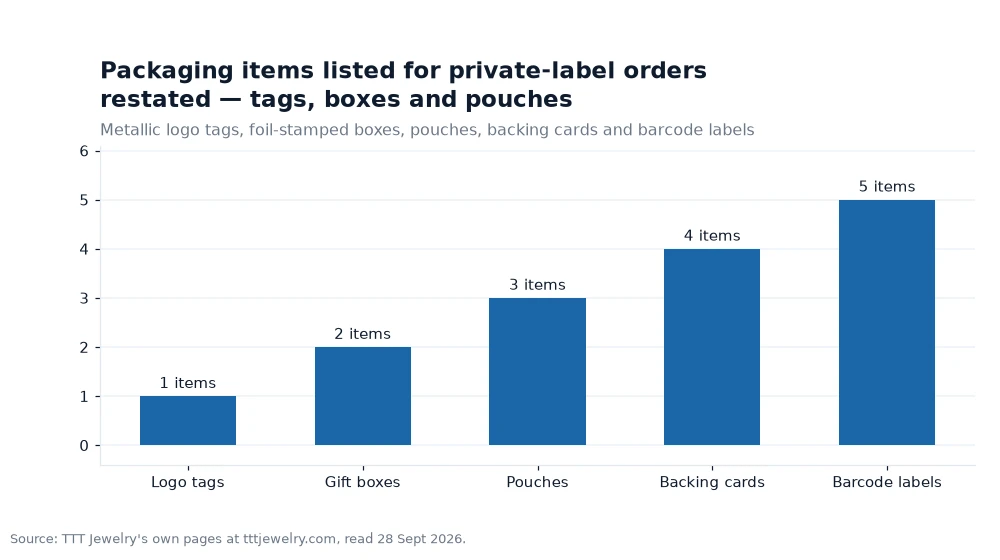
- Packaging is five separate decisions — tags, boxes, pouches, backing cards and barcode labels.
What a sketch can and cannot carry
A drawing carries silhouette, proportion and the placement of a stone. It rarely carries scale, and it never carries material or finish. Those are the four items that turn an idea into a job, and they are also the four items a factory cannot guess without risking a second sample.
So treat the sketch as half the brief. The other half is a short written list, and it can be provisional: a material with an alternative or a finish with a colour direction is enough for the CAD stage to start.
The four fields to put in the first message
14K, 18K or 24K gold, or rhodium — and for protection, anti-tarnish e-coating (silver and brass) plus PVD on stainless steel.
The mark is the third field, because it decides what the piece says about itself: a laser-engraved logo plus a purity hallmark reading 316L for stainless steel, an 18KGP mark on plated work and S925 on silver. Packaging is the fourth, and it is the one most often left for later, which is where the carton usually waits.
| You send | The factory returns | What you approve |
|---|---|---|
| Sketch, reference photo or tech pack | Feasibility and material guidance | The direction, in writing |
| Material and finish notes | 3D CAD drawings and renderings, under 48 hours | Dimensions and proportions |
| Mark and hallmark requirements | Engraving placement on the rendering | Where the logo sits |
| Packaging list | Tags, boxes, pouches, cards and barcode labelling | How the unit ships |
| First-run quantity | Confirmation against the material minimum | The batch size |
Where a rough drawing gets refined
Refinement happens in two places, and only one of them is expensive. The CAD stage produces technical drawings and realistic renderings inside 48 hours, and that is where a hand drawing becomes measurable: wall thickness, stone seat, bail diameter, engraving area.
The master sample is the other place, and it takes 25–30 days because it covers the 3D wax print, casting in a precision mould, then stone setting, gloss polishing and electroplating to spec. Anything still being decided when the wax is printed is being decided at the most expensive point in the process.
Worked example: three CAD rounds against one sampling window
Suppose the sketch needs three passes at the CAD stage. At under 48 hours each, that is roughly 3 × 2 = 6 working days of design time. Compare it with the shortest published sampling window of 25 days: 6 ÷ 25 = 0.24, so three rounds of screen work consume under a quarter of a single sample.
Run the same three changes after the sample arrives and each one costs a new sample rather than a new render. Three extra samples at 25–30 days is 75 to 90 days, which is longer than the whole eight-step order the drawing was meant to start.
Deciding the packaging list at briefing time
Five items, five decisions, and each one is easier to make before the batch exists than after. Bar-coded labelling, velvet/microfiber pouches, metallic logo tags, foil-stamped boxes and backing cards for display make a carton sellable through a system.
Write the list into the same message as the sketch. A private label jewelry manufacturer that quotes packaging with the piece can confirm the whole unit at once, and the final step of the published process is packing and shipping rather than shipping alone.
What happens to the drawing after approval
Once the dimensions are signed, the drawing becomes a mould. Prototyping follows the CAD approval, the wax print and the casting follow the mould, and the design, the CAD files and the mould itself stay exclusive to your brand under a 100% NDA — they are not resold or shown to another client.
That is why the approval is worth being deliberate about. A dimension approved casually becomes tooling, and tooling is the one item in the order that cannot be adjusted later without paying for it twice.
Briefs that create rework
Two patterns cause most of it. The first is a brief with no quantity, which cannot be checked against a minimum. The second is a finish described in a word that means something different to each person reading it.
Both are fixed the same way: use the published values rather than descriptions. Name 925 sterling silver, brass or stainless steel, name the plating as 14K, 18K, 24K or rhodium, name the mark as S925, 316L or 18KGP, and put a number on the first run. The sketch can stay rough.
Two sentences that save a sample
The first: what the piece must not look like. Referencing a competitor's piece as a starting point is normal practice, and naming the detail to change is far more useful than saying the design needs to be different.
The second: how the piece will be worn and by whom. That decides the base material more reliably than a stated preference does, because a pendant on a chain and a bracelet on a wrist put different demands on a finish, and the material minimums run along the same line.
How much detail is too much
A brief with forty measurements and no material decision is slower to answer than a single page with four fields, because the factory still has to ask the missing question before the CAD stage can start.
Where a tech pack exists, send it. Where it does not, a rough sketch plus four written fields is already a working brief, and the 48-hour CAD stage will show whether the proportions hold up.
Frequently asked questions
Is a hand drawing enough to start an order?
Yes. Rough drawings, reference photos and full tech packs are all accepted inputs, and the design team turns them into 3D CAD drawings and renderings inside 48 hours.
What should the first message include beyond the sketch?
Four fields: base material, finish, the mark or logo placement, and the packaging list, together with the quantity you expect in the first run.
How long is the wait after the sketch is approved?
Under 48 hours for the CAD file, then 25–30 days for the master sample, then 3–4 weeks of production once the sample is signed off.
From pencil sketch to packed carton
The gap between a rough drawing and a shipped order is four written fields, and every one of them is published. TTT Jewelry lists the materials, the finishes, the hallmarks and the packaging options, so the brief can be assembled from the site itself. The brass jewelry range is the fastest route for a first plated design, and the OEM/ODM comparison shows which of the two routes suits a sketch that is still open.
The figures used above — the four plating finishes; the six customisation variables and sampling over 25–30 days — are drawn from tttjewelry.com, checked 28 Sept 2026. Nothing else here is inferred. Reading the published windows against each other is my own construction rather than the manufacturer's[1].